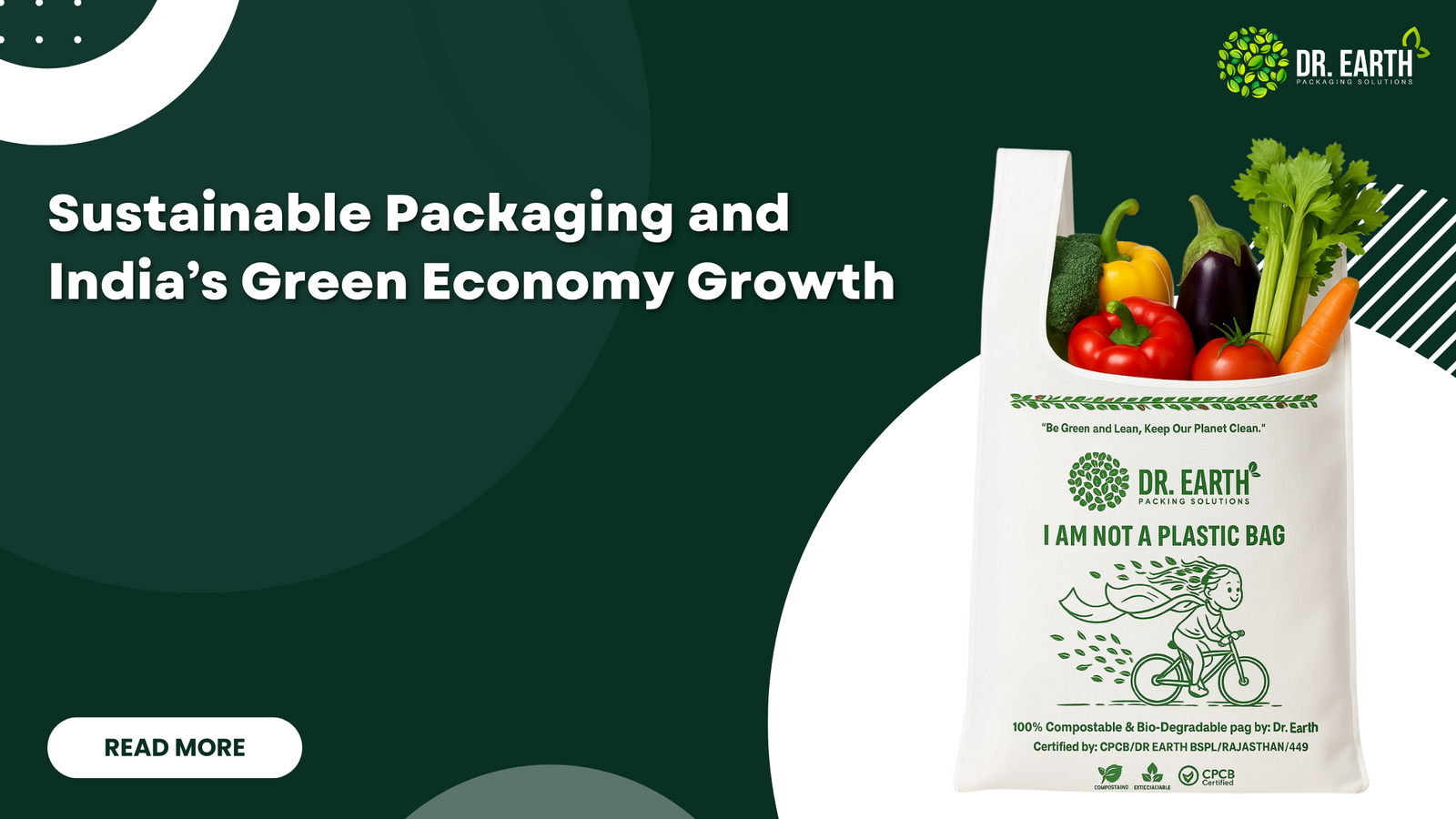
India’s green economy is at a pivotal point — a balance between economic development and environmental accountability. With the world’s fastest-growing economy, India is experiencing rapid urbanization, increasing consumption levels and expansion of industries. At the same time, there is growing pressure on India to tackle climate change, eliminate plastic pollution, and mitigate depletion of natural resources.
In this rapidly changing environment, sustainable packaging has become an important contributor to the growth of India’s green economy — creating jobs, boosting domestic manufacturing, helping to achieve regulatory goals, and reforming business models.
Sustainable packaging is not only an environmental trend; it is becoming an economic opportunity that reconciles growth and accountability.
Understanding India’s Green Economy
A green economy is defined as an economy that produces:
- Environmentally sustainable
- Resource-efficient
- Inclusive and employment-generating
India’s green economy encompasses many sectors that include renewable energy, electric mobility, sustainable agriculture, waste management, and increasingly, eco-friendly packaging options. Packaging is a vital component of the Indian green economy, as it intersects with almost all industries: food, retail, health care, logistics, e-commerce, and manufacturing.
As India’s consumption levels grow, so does the impact of product packaging on waste generation, landfill pressures, and carbon emissions.
The Packaging Problem Holding Back Growth
Plastic packaging has enabled convenience and provided a very low-cost option for consumers due to its ability to be mass-produced and shipped quickly. However, plastic packaging has created very long-term environmental impact as seen in:
- Plastic waste can last for decades,
- Many cities have a low recycling rate for plastics,
- Many types of plastic packaging are mixed or too contaminated to be processed for recycling, resulting in putting tons of plastic into landfills.
- Microplastics are found in soil, water, and food chains.
If an economy is trying to grow sustainably, then all of the above challenges will become economic liabilities that will have negative consequences for people, municipal budgets, tourism, and the reputation of global trade.
How Sustainable Packaging Fits into India’s Growth Story
Sustainable packaging (compostable, recyclable, reusable) allows India to decouple its economic growth from using the environment. Sustainable Packaging will:
Key ways it supports green economic growth:
- Lower the cost of landfilling and waste management.
- Encourage more circular economy models.
- Strengthen the domestic manufacturing base.
- Create green jobs throughout the entire value chain.
- Improve compliance with the environmental regulations.
More and more, companies are beginning to see sustainability not only as a cost but also as a growth driver.
Boosting Local Manufacturing and MSMEs
Sustainable Packaging is a key driver for building India’s Green Economy by supporting local manufacturing.
Sustainable Packaging also requires significantly less dependency on imported raw materials (such as petroleum-based plastics), since:
- They are made from agricultural by-products (corn starch, bagasse cellulose)
- They are made from renewable materials sourced locally
- They are manufactured/processed by India-based companies
This creates opportunities for:
- Micro, Small and Medium-sized Enterprises (MSME)/regional manufacturers
- Job creation in both rural and semi-urban areas
- Decentralized production clusters
As demand for sustainable packaging continues to rise, Indian manufacturers have expanded operations by building new facilities in India instead of importing products from other countries. As a result, jobs from sustainable packaging production will support the ‘Make in India’ vision.
Job Creation Across the Value Chain
Sustainable Packaging creates jobs beyond just production facilities. It creates jobs throughout the entire ecosystem associated with Sustainable Packaging, including:
- Processing raw materials
- Manufacturing & Quality Control
- Logistics & Distribution
- Waste Collection & Segregation
- Composting & Recycling Infrastructure
Jobs generated as a result of sustainable packaging are long-term, location-specific jobs that further contribute to India’s overall green employment objectives. Sustainable packaging is projected to increase in adoption as regulations become stricter, therefore creating further demand for skilled/trained employees (both skilled and semi-skilled) over time.
Supporting India’s Circular Economy Goals
In India, businesses are taking the next steps towards a circular economy, which would ensure that any waste produced by the economy will be seen as a valuable resource and not an unwanted burden on society. The role of sustainable packaging will be essential to this transition:
- Using compostable packaging allows for nutrients to be returned to our soil,
- Reducing the use of virgin materials through recycling,
- Lowering overall consumption with the use of reusable packaging,
By keeping materials in circulation, companies will become less dependent on finite resources while creating economic value from waste streams.
Alignment with Government Policies and Regulations
As India continues to change its laws and policies toward sustainability, businesses will have the opportunity to align their strategy with existing regulations and legislation. With a growing number of regulations, such as:
- The ban on single-use plastics,
- Extended Producer Responsibility (EPR) legislation,
- Mandates for waste segregation,
Companies will need to consider how they meet their sustainable packaging needs.
Sustainable packaging allows companies to:
- Stay compliant with evolving laws
- Reduce regulatory risks and penalties
- Qualify for government tenders and partnerships
From a macroeconomic perspective, compliance-driven sustainability strengthens governance while enabling long-term industrial stability.
Enhancing Global Competitiveness
Indian businesses can use sustainable packaging to differentiate themselves from competitors globally as there is an increasing global focus on Sustainability within businesses and on products marketed internationally.
Using Sustainable Packaging Provides Opportunities For Indian Business To:
- Meet international environmental standards
- Improve ESG (Environmental, Social, Governance) scores
- Attract global clients and investors
- Strengthen brand trust in overseas markets
This positions India as a responsible manufacturing hub rather than just a low-cost producer.
Consumer Demand as an Economic Driver
Environmental Awareness Is Increasing Among Many Consumers In India Including Urban Dweller, Millennials & Generation Z.
Indian Consumers Are:
- Seeking Brands Offering Sustainable Packaging
- More Likely To Ask About Delivery Options (With Less Plastic)
- More Likely To Reward Companies That Behave As Good Corporate Citizens.
Changes In Consumer Behaviour Are Driving Demand For Sustainable Packaging; Therefore, They Will Drive Economic Growth Again.
Challenges and the Road Ahead
The momentum is strong, but challenges still exist:
- Gaps in Composting and Recycling Infrastructure
- Your Business Therefore the Increased Cost of Initial Investment
- Lack of Awareness Regarding Proper Disposal
The above challenges represent growth opportunities for: Innovation, Investment, & Public-Private Collaboration.
Once the infrastructure is improved and becomes bigger in scale, Sustainable Packaging will become less expensive, more accessible to smaller businesses, and Span a larger mass of people using these new Sustainable Methods.
The Bigger Picture: Growth Without Compromise
It’s been said before, but it’s worth repeating—India does not have to make a choice between its economic growth and environmental responsibility. Sustainable packaging demonstrates that both can progress together.
Sustainable packaging is an integral part of India’s desire to build a green economy by reducing waste, providing jobs, creating employment opportunities for local manufacturers, and aligning with sustainable requirements on the world stage.
Conclusion
Sustainable Packaging: No Longer a Niche Concept, but Rather A Key Economic Tool In Shaping The Future Of India. As the various industries change and government regulations tighten, those companies adopting sustainable packaging will not only help save the planet, but they will also make a vital contribution to the story of India’s green growth.
Going forward, the use of Sustainable Packaging will play a key role in helping to ensure India’s economic advancement is: Robust, Inclusive, and Environmentally Responsible.
FAQs