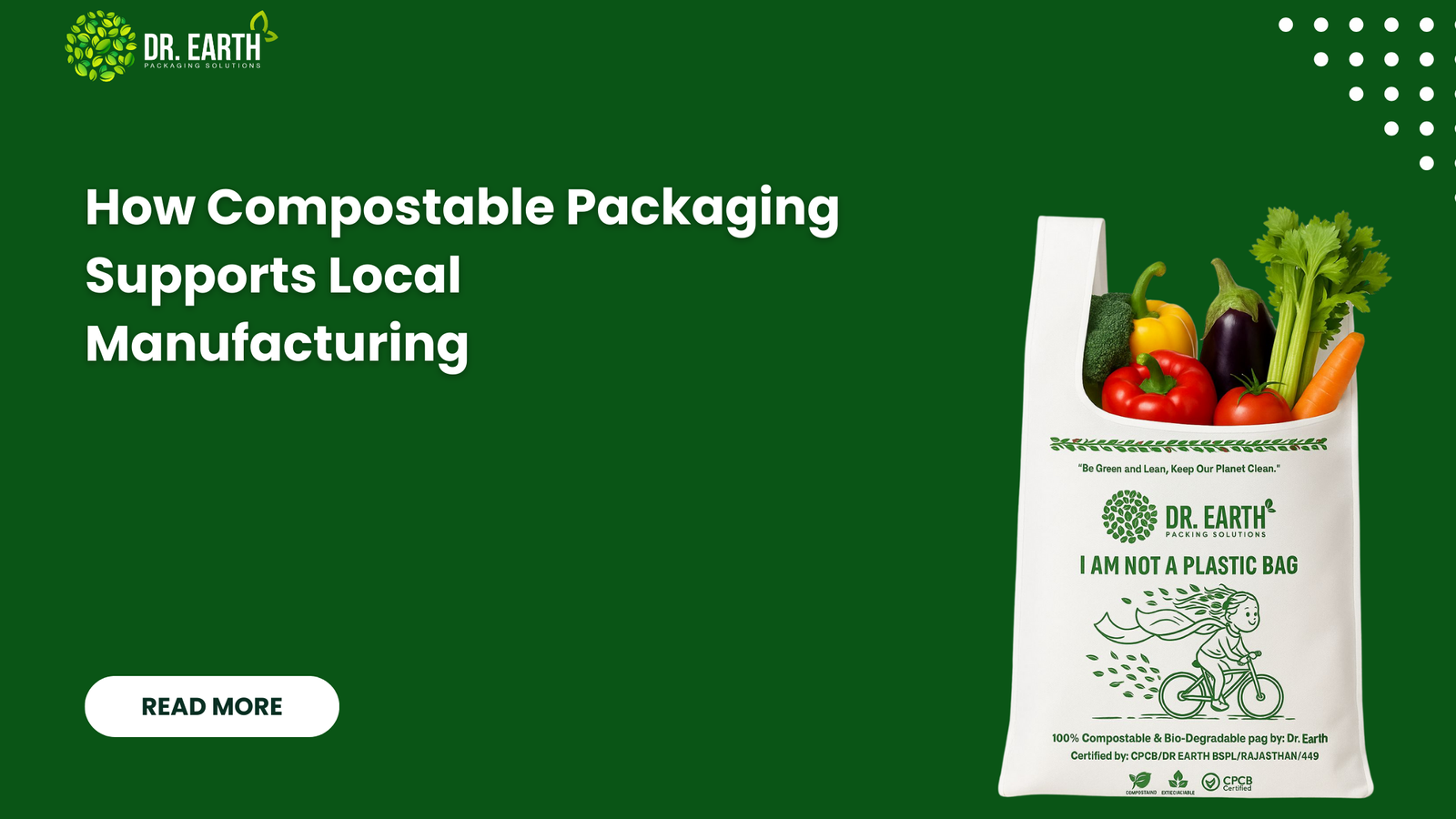
The Government of India has made large strides towards sustainable development. This has moved beyond just creating an environmentally-friendly climate to becoming an essential part of the manufacturing strategy that helps drive economic growth and job creation in India and at the same time supporting the growth of our local hand-made manufactured products.
In addition to being an eco-conscious alternative to plastic, compostable/package-based products have become one of the most powerful tools available to grow and expand domestic manufacturing capabilities and self-sufficiency of the local industry. Compostable packaging encourages local sourcing and decentralized production of goods helping to create job opportunities based on skill sets within the local population. Thus, it is helping to grow and develop the entire local manufacturing ecosystem in India.
The Shift Away from Plastic and What It Means for Manufacturing
The majority of plastic packaging produced today comes from the vast petrochemical processing facilities which make up a large part of the global petrochemical sector. There is an over-reliance on overseas sources for obtaining raw material components which means that economic gains associated with bulk/volume sales of plastic packaging will remain in just a few regions or industries.
Compostable Packaging Displaces Traditional Packaging
By using renewable resources (corn starch, sugarcane waste, agricultural waste products, and cellulose) as the basis for compostable packaging materials, we can source these component materials from local agricultural supply chains throughout India. The supply chain will consist of a substantially different structure; all of the manufacturing and processing will occur much closer to the source of the component materials than what can occur with conventional plastic.
Increased demand for compostable packaging will result in increased manufacturing of compostable products occurring much closer to where the raw materials exist than it currently occurs, resulting in manufacturing occurring in more local production sites rather than in larger more centrally located industrial clusters.
Local Raw Materials Fuel Local Industries
Compostable Packaging helps fuel local manufacturing by supplying the raw materials needed to produce. Unlike traditional materials (plastic) made from petroleum-based products, they do not need to come from other countries or regions.
India has an abundance of waste products from agriculture such as bagasse, crop residue, and starch-based materials. Most agricultural by-products are classified as “waste” or “underused”. Compostable Packaging gives value to the waste by turning it into valuable materials.
This creates opportunities for:
- Agricultural producers & processors to provide raw materials for packaging
- Small manufacturing businesses to convert Agriculture waste into raw materials
- More efficient regional supply chains to deliver these raw materials at a lower cost than trucking.
By connecting Agriculture to the packaging industry will benefit Rural Communities, while reducing the need for imported raw materials.
Boosting Small and Medium Manufacturing Units
In comparison, compostable packaging is a much better fit for small and medium enterprises (SME) than plastic packaging. While the production of plastic products requires a considerable amount of up-front investment, large-scale manufacturing equipment and high energy requirements, compostable packaging can be produced using:
- Modular manufacturing techniques
- Lower capital investment required for start up
- An easier path for SMEs to enter the market
- Ability to produce inventory as required based on local demand
This is especially true in India where the manufacturing landscape consists primarily of SMEs. Compostable packaging enables small manufacturers to take advantage of a fast growing sector without the fear of being outrun by larger players. As a result, production will occur throughout many regions and not just concentrated in a few industrialized areas.
As a result, production is distributed across multiple regions instead of being concentrated in a few industrial belts.
Job Creation Across the Value Chain
Local jobs are created along the value chain as the local manufacturing of compostable packaging creates jobs at multiple levels. Raw material processing through manufacturing of finished goods creates jobs.
Potential job creation includes:
- Material processing and compounding
- Manufacturing of bags and packages
- Testing and certification of quality
- Maintenance of production equipment
- Logistics and distribution
- Waste management and composting support
Employment opportunities in India will not only arise from factory floor jobs, but also through the creation of skilled technicians, compliance experts, sustainability professionals, and logistics professionals to help the manufacture and promote compostable packaging.
There is an opportunity for India to build a new sustainable ecosystem of employment through compostable vs plastic products.
Encouraging Regional Manufacturing Clusters
The creation of compostable packaging creates the opportunity to develop regional manufacturing clusters vs large centralised manufacturing facilities. As raw materials can be obtained locally and demand exists throughout the various cities and towns in India, manufacturers have the ability to develop their production facilities close to their consumers.
The production of compostable packaging will result in:
- Lower transportation emissions
- Lower logistics costs
- Faster supply cycles
- More regional economic strength
As composite packaging production facilities are built up within the states that have strong agricultural production and waste management systems, these states will be the primary hubs for compostable packaging manufacturing. Over time this decentralised development will help to strengthen India’s overall manufacturing resilience.
Strengthening “Make in India” and Self-Reliance
The goal of improving India’s self-sufficient manufacturing capabilities by 2025 cannot be accomplished by continuing to rely on the importation of plastic resins, and chemicals used to manufacture plastic products. The production of Compostable packaging fits into India’s national initiatives such as Make in India and Aatmanirbhar Bharat.
As compostable packaging materials are locally grown and manufactured, all of the value created is kept within the country. By keeping all of the manufacturing costs within India, domestic manufacturers will have greater control over pricing, supply stability, and innovative operations.
This will provide more protection for the businesses through any disruption, related to the global supply chain.
Innovation and Skill Development in Manufacturing
Manufacturers have an opportunity to innovate as compostable packaging continues to develop.
Manufacturers are improving the performance of compostable packaging (by focusing on improvements in strength, shelf life, heat resistance, and moisture control) to meet their customers’ requirements. As a result these manufacturers are expanding their
This drives:
- Research and development efforts
- Cooperation with scientists and/or engineers in the development of packaging materials
- Development of manufacturing skills using green technologies
Not only do local manufacturers produce compostable packaging, they are also active participants in developing new materials for compostable packaging.
Compliance-Driven Demand Strengthens Local Supply
With the ongoing trend toward governmental mandates to restrict the use of single-use plastics, there has been an increase in the demand for compostable products. Retailers, food delivery services, hospitality providers, healthcare providers, and event planners, are sourcing compliant packaging solutions.
Local manufacturers of compostable packaging are benefitting directly because of this shift in government regulations. Companies are now choosing to purchase their packaging from domestic suppliers, rather than from companies that do not comprehend how to comply with local regulations and waste management systems. Thus, since local businesses prefer to purchase from domestic suppliers, there has been a stable long-term demand for products manufactured by Indian companies leading to additional investments in the industry and the expansion of manufacturing capacities.
Reduced Environmental Cost, Increased Economic Value
The manufacturing of plastic often places its environmental burden on municipalities and taxpayers by vicariously externalizing those costs through cleanup and waste management. On the other hand, correctly processed compostable packaging reintegrates into natural systems.
Through a reduction in landfill pressure and plastic pollution, compostable packaging creates savings for public waste management, which enhances economic stability, as well as allowing government reinvestment into infrastructure and manufacturing incentives.
Local manufacturing benefits when sustainability and economic logic are aligned; rather than opposing one another.
The Role of Responsible Manufacturers
Compostable packaging manufacturers in India play a significant role in providing quality, certification, and performance guarantees. Manufacturers who are reputable invest in production standards, compliance, and testing, which allows compostable packaging to be a realistic alternative for businesses.
By creating durable and certified compostable packaging that meets the typical climate conditions of India, manufacturers will be able to assist businesses in transitioning from plastic with little to no disruption to their operations. Trust is crucial to increasing adoption rates and maintaining the continued growth of local manufacturers.
Looking Ahead: Compostable Packaging as an Industrial Opportunity
The transition from a niche category to a widely adopted product category due to the risk of sustainability becoming a requirement for all businesses will lead to compostable packaging being used by all companies over time. The evolution of compostable packaging is not going to be a fad, but rather an opportunity for long-term growth.
As manufacturers continue to respond to:
- Enactment of stricter regulations on plastics
- Greater awareness amongst consumers about environmental impact
- Improvements in waste management and recycling systems
- Expansion of circular economy models
Due to the strong agricultural base, expanding MSME sector, and strong government policy direction, India can be a world leader in the manufacture of compostable packaging materials.
Conclusion
In many ways, compostable packaging does much more than replace plastic; it changes the way packaging is made, who is involved in producing it, and where value is created within the economy.
Compostable packaging provides numerous benefits to India’s sustainable industrial future by sourcing local raw materials, empowering MSMEs, creating skilled jobs, and enhancing local manufacturing capacity.
As businesses, governments, and consumers continue to prioritise sustainability, compostable packaging will remain a key driver of locally produced packaging and demonstrate that economic and environmental goals can move forward together.
FAQs
Compostable packaging relies on locally available agricultural materials and decentralised production, which helps Indian manufacturers reduce import dependence and build regional supply chains.
While initial costs can be slightly higher, local sourcing, regulatory compliance, and long-term savings make compostable packaging economically viable for manufacturers.
Yes, compostable packaging allows modular and scalable production, making it suitable for MSMEs and regional manufacturers across India.
Food delivery, retail, hospitality, healthcare, events, and waste management sectors benefit the most due to high packaging consumption and regulatory requirements.
Yes, growing regulations, consumer demand, and sustainability goals ensure stable demand, making compostable packaging a long-term opportunity for Indian manufacturers.
Share:
Related Posts



Send Us A Message
Related Posts