Rethinking Everyday Packaging for a More Sustainable Future
Dairy Is Everywhere — And So Is Its Packaging
Every day we consume dairy. Where do we get it? In the morning, we drink milk, put yogurt into a container, buy butter wrapped in plastic, buy paneer wrapped in some sort of packaging, and buy cheese sliced for sandwiches. Dairy is an extremely important part of everyday life because it consists of so many products and is so large in terms of volume, particularly in India.
Every product we buy comes with some kind of container or package; most of them are plastic. Unlike occasional purchases, we consume dairy products on a daily basis. Therefore, the amount of waste produced from dairy products is vast and ongoing.
The question now is no longer whether this is a problem. Instead, the real question facing us is, “Will the dairy industry continue to grow in size without increasing its environmental impact?”
Compostable packaging is becoming a viable option for addressing this issue.
The Challenge: Freshness vs Sustainability
Dairy products are very sensitive in nature and need a package to prevent them from:
- Moisture
- Air exposure
- Contamination
- Temperature changes
Hence, plastic has been the most commonly used material for dairy packaging for several years.
It is a light-weight material and is very flexible to work with, plus it does a wonderful job of keeping the freshness of the dairy.
However, plastic has long-term consequences.
Plastic does not break down naturally, but rather stores up in landfills and breaks down into microplastics over time.
For an industry that deals with food and health, it is difficult for them to continue to ignore this contradiction.
Consumers have started to notice this, and regulators are starting to question the use of plastic packaging, and manufacturers are being pressured to find new alternatives.
A Shift in Consumer Expectations
Consumers today are more aware than ever.
- Consumers are not only buying milk and butter. They are buying into a company’s values.
- When they see excessive plastic packaging used for dairy products, they feel a level of “friction.”
When they see eco-friendly packaging options, they feel a sense of “trust.”
When a dairy company changes its packaging to compostable options, they are not just solving a waste problem; they are building relationships and creating/enhancing customer loyalty.
- They show they are responsible.
- They show they are aware.
- They show they are leaders in the dairy industry and can shape the future dairy industry for the better.
Where Compostable Packaging Fits in Dairy
At this stage in the evolution of compostable packaging, it is not yet ready to fully replace traditional dairy packaging, particularly where there are strict requirements for barriers to preserve liquid.
That said, it has already been used effectively in many different applications.
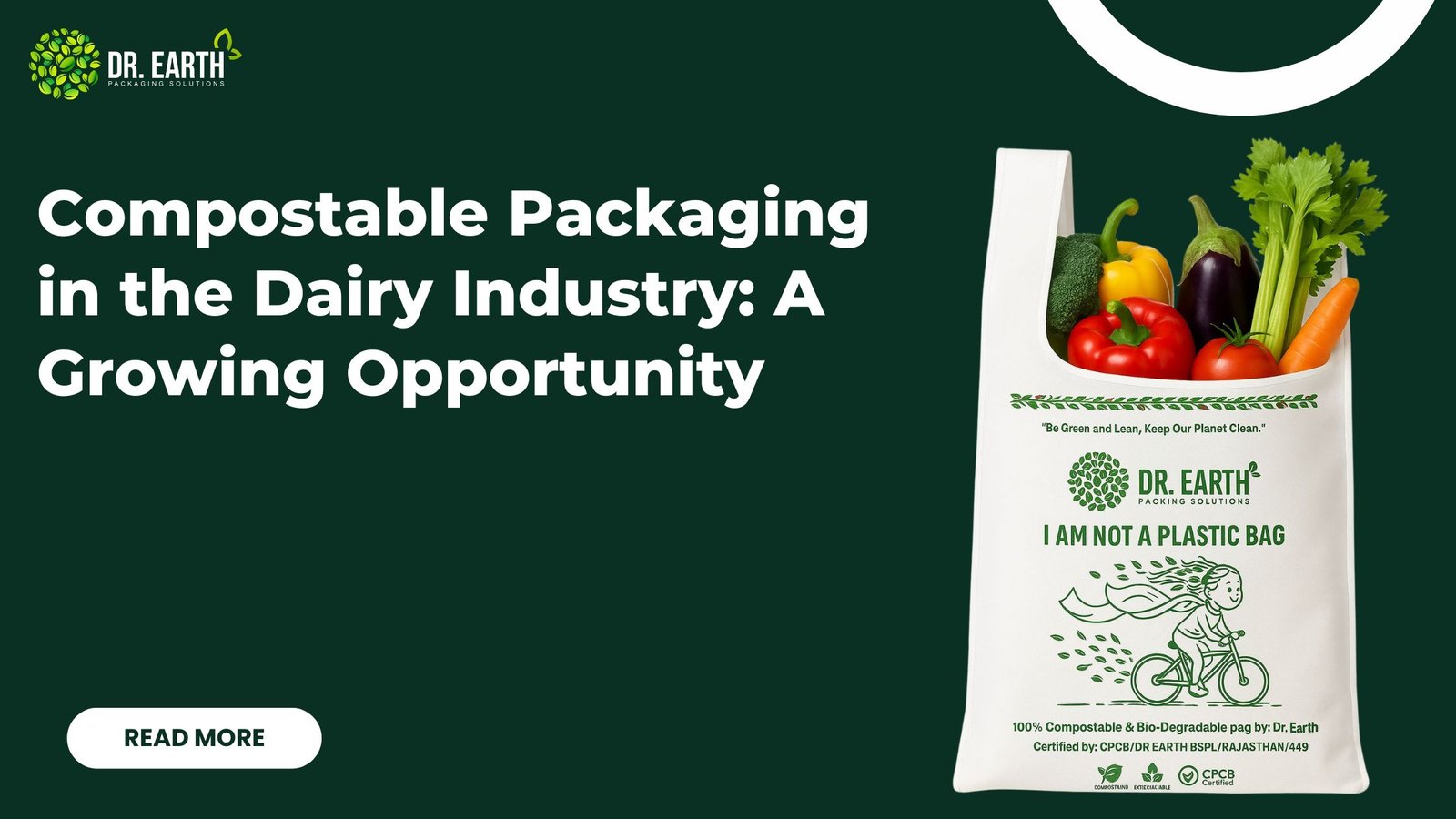
Among those are retail stores’ outer packaging of dairy goods, as well as secondary shipping containers for dairy products; and using compostable bags to carry dairy products from the store to home would not only remove the use of plastic but also eliminate long-term waste.
In addition, some of the organic materials that result from dairy production and processing are generally included with organic food waste in the normal waste stream, which results in increased disposal costs and complexity. However, with compostable liners, the disposal of these materials can be simplified, and waste management improved.
The best approach is to start with the highest impact, where compostables can have the most immediate impact, and then expand from there.
Reducing Daily Plastic Waste at Scale
Dairy is a commodity business based on volume.
A small change can have a huge impact when multiplied over millions of transactions.
For example, implementing compostable carry bags in place of plastic carry bags in grocery retail for dairy products will create not only a visible difference but also an impact that is measurable.
Over time, this reduces:
- Plastic waste entering landfills
- Environmental pollution
- Waste management pressure
It also aligns the business with future sustainability goals.
Supporting Better Waste Management Systems
One of the greatest issues in managing waste is that of “mixing” organic matter with plastic.
When these materials are mixed, we run the risk of not being able to effectively manage the waste stream. We may then run into problems with compost and recycling processes. Compostable packaging offers a solution to this issue. Organic materials and their packaging can be processed together and, therefore, eliminate the need for separation.
In a dairy operation in which organic waste typically makes up the majority of the waste stream, compostable packaging represents a significant opportunity to ensure a cleaner waste stream and a more efficient composting process.
Strengthening Brand Positioning in a Competitive Market
The competitive landscape in the dairy industry is fierce.
Most dairy products are similar in terms of quality and price. Generally speaking, branding and brand perception are largely what separate products. The sustainability of a product is becoming increasingly important in this regard.
A company that utilizes compostable packaging is noticed more than one that doesn’t.
Not so much for volume, but rather for the message it sends.
That being said, a company that uses compostable packaging is clearly thinking beyond just today’s profit. Rather, they are considering the long-term implications of the decisions that they make today.
This aspect of sustainability plays a major role in the customer’s purchasing decision:
- It builds loyalty,
- It creates recall and name recognition for the brand.
Aligning with Regulatory Trends
The regulatory burden related to plastic consumption in India is slowly tightening. The use of single-use plastics is being restricted, the waste management rules continue to change, and businesses are being required to be responsible for their packaging.
The dairy industry will not be immune to these changes.
By adopting compostable packaging early, businesses can position themselves ahead of these changes.
By creating systems and processes that are already in alignment with future regulations, they will experience less risk and have more seamless business operations.
Addressing Cost and Practicality
When it comes to cost, there is always a concern. While compostable packaging seems more expensive compared to current methods of packaging, focusing on initial costs only tells part of the story.
When factoring in elements such as:
- Brand reputation
- Customer loyalty
- Regulatory compliance
- Waste management efficiency
Businesses will find it easier to justify the investment.
As companies grow and the market has more demand, the cost of compostable packaging continues to become more competitive.
What was once thought of as a premium option is now becoming practical.
The Role of Technology and Innovation
There is no one path forward for future dairy packaging.
Innovation will fuel the future of dairy.
New materials are being created to enhance barrier properties and to research compostable packaging suitable for more direct applications.
At the same time, waste management frameworks will also evolve to help support compostable materials.
The solution to future growth will be a synthesis of material innovation with systems improvement.
Why Quality Matters in Compostable Packaging
The dairy sector requires reliable packaging.
It must provide consistent performance, support weight and moisture, as well as the real world.
When using low-quality alternatives, packaging can result in problems and harm brand reliability.
This is why the selection of the right partners is needed.
Dr Earth aims to deliver compostable packaging that meets practical needs while safeguarding our environment.
The aim is to go beyond just replacing plastics with an alternative solution that offers functionality in everyday operations.
A Practical Path Forward
Adopting compostable packaging is not difficult; there are many different ways to begin the process of adopting compostable packaging.
Start small and begin with a small scale of retail carry bags and offer compostable options for packages in supply chain stages where product safety is not affected.
Implement changes with your waste management system to better manage waste generated from your operations.
The cumulative effects of implementing compostable packaging materials create an efficient and responsible system for reducing the carbon footprint of dairy companies.
The Bigger Opportunity
Dairy contributes to feeding millions of individuals, which is important for providing food and nutrition to people daily.
With the potential of using compostable materials in the dairy packaging, it would be able to take on an even larger supportive role. Not only is it designed to give nourishment to individuals, but it also preserves the environment.
It is often stated that the goal of reducing waste is a key focus, but that is only half of the equation. Additionally, there will be a huge shift in the meaning of responsibility as a result of this technology.
In closing, we believe that there are numerous ways for the dairy industry to make an impact with compostable materials.
Final Thoughts
The dairy industry has a growing opportunity with compostable packaging.
- It offers a way to balance freshness, safety, and sustainability.
- It allows businesses to reduce environmental impact without compromising performance.
- And most importantly, it aligns the industry with the expectations of the future.
At Dr. Earth, we do not believe that change happens overnight.
Rather, change occurs gradually through individual decisions – and sometimes through the simplest of changes, such as the use of a bag.