The Rise of Quick Commerce — and an Overlooked Problem
Quick commerce has completely changed how people shop today. As an example, you can receive groceries, everyday essentials, and snacks from platforms like Blinkit, Zepto, and Instamart within minutes. Gone are the days when you need to schedule your time to buy groceries or do any other kind of shopping.
With this form of convenience, customers have formed a new shopping habit. No longer do customers only do one weekly grocery run; instead, customers will now do dozens of small orders over the course of days. They will order milk in the morning, fruits in the afternoon, and snacks in the evening—all delivered almost instantly.
However, this new trend has presented an ever-increasing challenge that many do not see.
Each order has packaging.
Most of the packaging for these deliveries is likely single-use plastic.
When you multiply the number of orders (and packaging) being delivered now to all the customers (and the associated impact this has had) over the course of each day (for all delivery companies), what appears at the door will come from the cumulative effect of hundreds of thousands (if not millions) of individual deliveries—from just a single customer and over an extended period of time. While this may seem to be a small amount of plastic at the door, the impact this small amount of plastic has on the environment is large and will continue well beyond the time you received your delivery.
Packaging: The Silent Contributor to Waste
Role of Packaging in Quick Commerce, a Growing Market
Packaging has a greater role in quick commerce than in traditional retail because customers do not actually go into stores or interact with the shelves. Instead, the customer’s experience begins and ends with what is delivered to their home.
As such, the delivery bag is more than just a package; it is an extension of the brand.
When the delivery bag is made from plastic, it creates a disconnect for the customer, who may appreciate the speed and convenience of the delivery but is becoming more aware of the plastic waste created. Over time, this awareness will influence how customers view your brand.
As consumers buy more than just products, they are developing an opinion of your brand based on all the questions they have concerning sustainability (even when they may not express them), and these opinions carry weight in competing in today’s market.
Why the Current Model Is Not Sustainable
Quick commerce and frequent purchases, compared to e-commerce, where you might purchase something at most two to three times a week, result in a continuous cycle of waste, specifically in terms of packages.
Most of the plastic bags that are used for delivery are never reused. They are convenient to use, and designed for that reason alone, so when they are thrown away, they generally end up in landfills or worse, in the open environment, contributing to pollution and the creation of microplastics.
In addition to the environmental issues, there are structural issues with the current packaging model, in that it was not designed to support this kind of usage. Therefore, the impact of this will continue to grow and will compound.
Compostable Packaging: A Practical Solution
Creating sustainability in the quick commerce industry will not require a complete redesign of the system, but it may require smarter material selection.
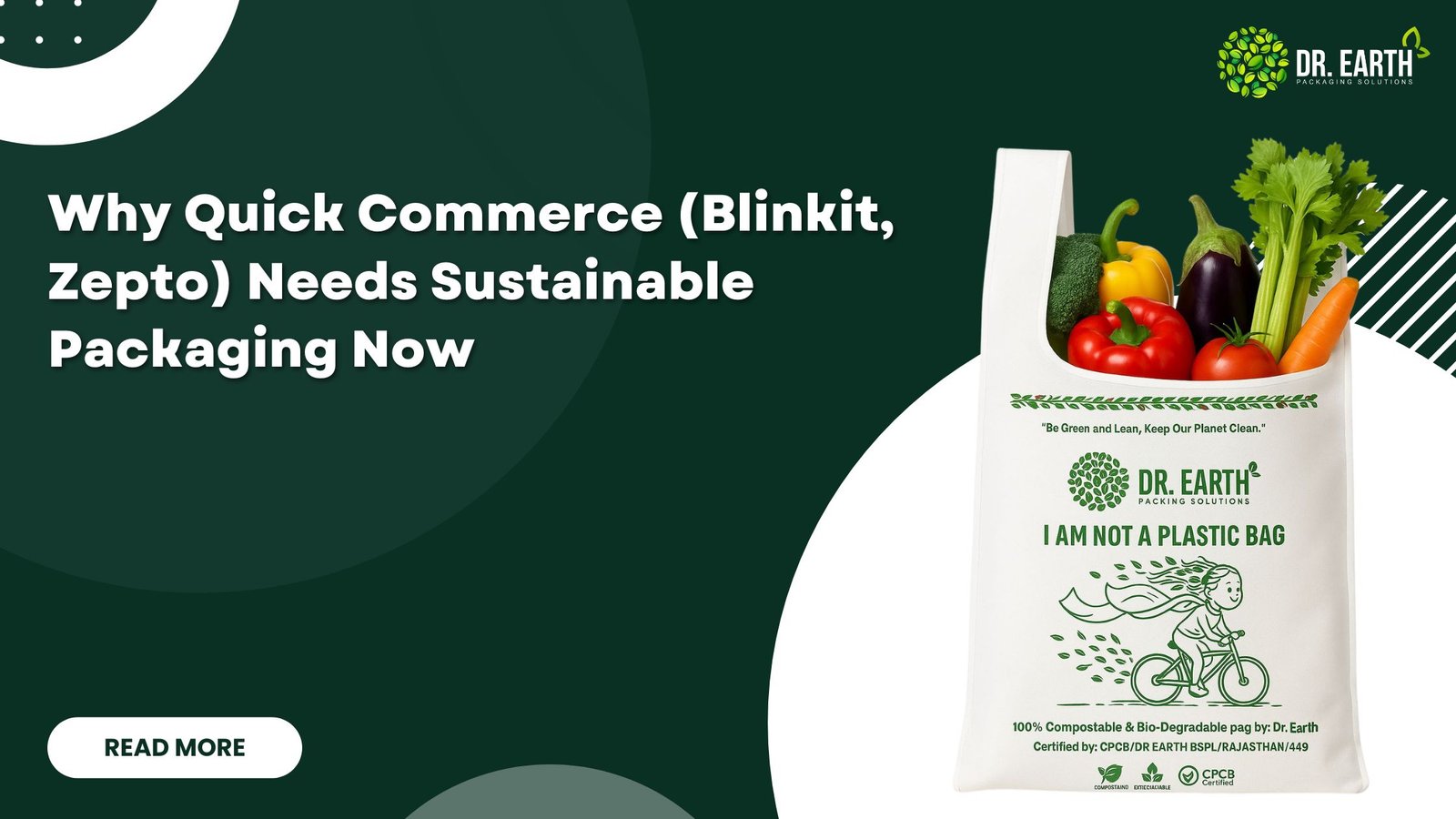
Compostable packaging provides a viable alternative to traditional plastic.
Traditional plastic is made from petroleum; compostable bags are made from a natural and sustainable source, that is, plant materials, and can be broken down into its natural elements under the right conditions.
Compostable bags will perform just as well as traditional plastic, meaning they can carry weight, hold moisture, and be durable, except they will not remain in our environment for decades after they are discarded.
In the quick commerce model, where packaging is used for a very short period of time and immediately disposed of, compostable bags would be a better alternative.
Enhancing Customer Trust Through Better Packaging
Consumer expectations are constantly changing. The speed of a delivery is only part of what defines a good experience. Being a responsible company is becoming just as important. A customer receiving a delivery packaged with compostable packaging will view the entire experience (including the company) differently.
The use of compostable packaging provides clear evidence that the company is considering more than simply delivering a product quickly and conveniently.
Using compostable packaging will elicit a positive emotional response from consumers. They will know that their decision to purchase from this company does not harm the environment and that they are “in sync” with the company.
As it is easy to switch between platforms in this market, building trust is both necessary and, ultimately, a key differentiator since sustainable packaging can affect both satisfaction and long-term loyalty to a brand.
Regulatory Trends and Future Readiness
The Indian government is moving to be more strict with single-use plastics, with increasing policies in place and the introduction of more enforcement mechanisms for the enforcement of these new policies. Businesses that are heavy users of plastic packaging will eventually be faced with compliance issues.
Given the scale and visibility of “quick commerce” platforms in the market, it is likely that they will be heavily impacted first by the implementation of increasing regulatory requirements.
By adopting compostable packaging at this time, companies can stay ahead of these changing regulatory requirements, mitigate the risk that a sudden operational interruption will occur as a result of a lack of compliance, and allow the company to be proactive about implementing these changes rather than reactive.
Preparing for the future is not only about logistics and technology, but it also involves developing a sustainable business strategy.
Operational Feasibility and Ease of Transition
Businesses often express concern that changing to compostable packaging will slow their operations down due to how complicated these transitioning will be. In most cases, this transition is very simple. Compostable bags can replace traditional plastic carryout bags and allow for little to no changes in packaging processes. They work in conjunction with existing systems and add no additional complexity for any company that uses compostable bags to operate.
When you select a quality supplier, you will have sufficient consistency between the quality and the supply of the products. Therefore, your daily operations will continue smoothly.
At Dr Earth, we are committed to providing compostable solutions that seamlessly integrate into your existing business workflow, allowing you to be sustainable without doing anything that disrupts your business.
The Business Advantage of Acting Early
Most people perceive sustainability as a requirement; however, many also perceive this same concept as a positive business advantage. Companies that adopt responsible practices early gain an edge in the marketplace over their competitors. They position themselves as innovative thinkers who are trustworthy. They attract consumers who care about the environment, and they develop a reputation for being able to provide products and services that do more than just meet price and speed expectations.
Whereas companies that take their time to make changes will find themselves being forced to adapt when under pressure, they’ll often end up having to pay a premium for this adaptation.
The quick commerce industry is continually evolving. This is an opportune moment for businesses to develop their own standards, rather than simply following the standards set by other businesses.
A Scalable Impact
The best thing that quick commerce has going for it is that it is scalable. A single initiative applied to millions of different orders creates a measurable amount of impact.
For instance, even though switching from plastic to compostable bags may seem like a modest contribution to reducing plastic waste, evidence shows that switching to a compostable option will provide a substantial amount of plastic waste reduction in total.
Furthermore, establishing this standard for suppliers, partners, and/or customers sets the stage for a wider transformation to sustainable packaging practices.
Final Thoughts
Quick commerce has changed the way people think about both speed and convenience.
What’s next? Defining responsibility in quick commerce.
When brands choose sustainable packaging, they don’t just show their support for the environment; they also support their business. How customers view a brand, how much they will trust it, and how long that brand will endure are all determined by a brand’s sustainability commitment.
Using compostable packaging enables companies to be more efficient while still reducing their environmental impacts.
At Dr Earth, we believe that true innovation occurs when companies are able to provide both speed and convenience as well as serve customers and communities responsibly. True innovation is not simply defined by being faster; true innovation is defined by being better!
Frequently Asked Questions